
Why Learning Data Management is the Ultimate Career “Cheat Code” for 2026
The job market of 2026 is no longer defined by what you know, but by how you manage the information that fuels the world. As artificial intelligence (AI) transitions from a “trendy tool” to the core infrastructure of global business, a singular discipline has emerged as the most critical pillar of the digital economy: Data Management.
While software trends and social media platforms fluctuate, the architecture behind them—the databases—remains constant. For professionals and students in the United States, mastering the art of organizing, securing, and analyzing data isn’t just a resume builder; it’s a career “cheat code” that offers unparalleled job security and salary leverage.
The Rise of the Data-Driven Economy
In the US, the Bureau of Labor Statistics (BLS) projects that roles related to data science and database administration will grow by over 25% through 2032, significantly faster than the average for all occupations. This surge is driven by the “Data Gravity” effect: as companies collect more information, they require more sophisticated systems to prevent that data from becoming a liability.
However, the complexity of modern systems—ranging from cloud-native architectures to NoSQL environments—has created a massive skill gap. For many university students, bridging this gap is the biggest challenge of their academic journey. It is common to feel overwhelmed by relational algebra or normalization, which is why seeking professional dbms assignment help has become a strategic move for those who want to ensure their foundations are rock-solid before entering the competitive workforce. This isn’t just about finishing a task; it’s about mastering the logic that will govern the next decade of tech.
Why Data Management is Your “Cheat Code”
1. The “AI-Proof” Skillset
Automation is disrupting many sectors, but it cannot easily replace the human logic required to design a scalable database. AI models, including Large Language Models (LLMs), are only as good as the data they are trained on. Professionals who understand Data Governance and Database Integrity are the ones “teaching” the AI. By controlling the data, you control the output of the automation.
2. Cross-Industry Versatility
Unlike niche skills that tie you to one sector, database management is a horizontal skill. Whether it’s a healthcare provider in New York managing patient records, a fintech startup in San Francisco securing transactions, or a retail giant in Chicago optimizing supply chains, they all run on SQL, Oracle, and MongoDB. This versatility allows you to pivot between industries without starting from scratch.
3. The High-Salary Floor
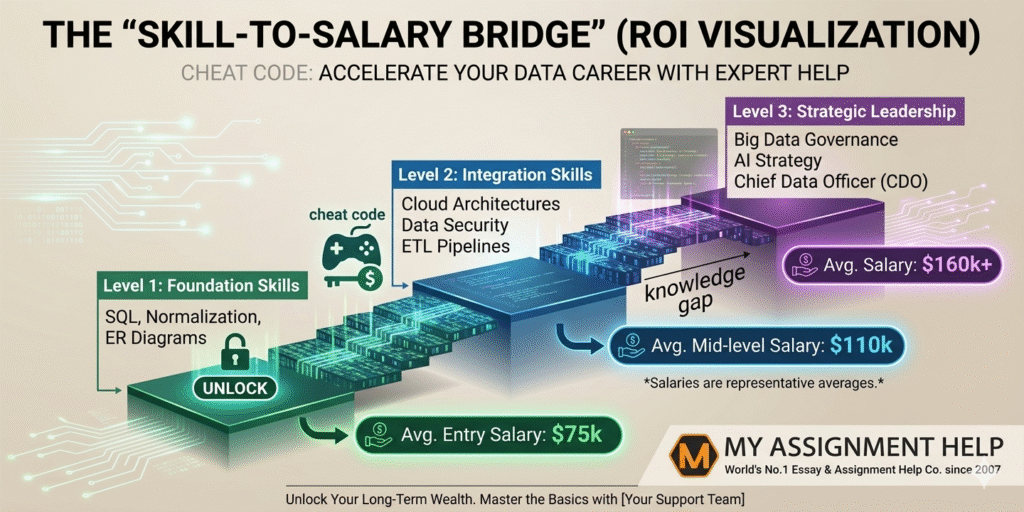
According to Glassdoor and Payscale 2025/2026 projections, entry-level database administrators (DBAs) in the US can expect starting salaries ranging from $75,000 to $90,000, with senior architects easily clearing the $160,000 mark. When you consider the ROI on the time spent learning these skills, the numbers speak for themselves.
Navigating the Academic Learning Curve
The transition from a general interest in tech to a professional data manager involves rigorous academic training. Many students find that the workload in 2026 has doubled as curriculums now include “Big Data” and “AI Ethics” alongside traditional schema design. When the pressure of multiple deadlines converges, it can be a smart management decision to buy an assignment from experts who understand the current industry standards. This allows students to focus on high-level conceptual learning while ensuring their GPA remains competitive for top-tier internships.
Key Takeaways for 2026
- Data is the New Oil: But just like oil, it must be “refined” through proper management to be valuable.
- Stability Over Hype: While “AI Prompt Engineering” is a trend, Database Administration is a foundational necessity.
- Interdisciplinary Value: Marketing, Finance, and HR are all becoming “Data-First” departments.
- Strategic Assistance: Utilizing expert academic resources is a legitimate way to manage the steep learning curve of technical degrees.
See also: Blockchain in Supply Chains: Transparency Redefined
Understanding the Modern Research Stack
To succeed in this field, one must move beyond simple textbook learning. The “Modern Research Stack” for a data professional in 2026 involves:
- Technical Proficiency: SQL, Python, and R.
- Architectural Knowledge: Understanding the difference between Data Lakes and Data Warehouses.
- Ethics & Compliance: Mastering US data privacy laws like CCPA and GDPR-aligned frameworks.
FAQs
Q: Do I need a Computer Science degree to work in Data Management?
A: While a degree helps, many US employers now prioritize “demonstrable skill.” Certifications (like AWS Certified Data Analytics or Oracle Database SQL) combined with a strong portfolio of projects are increasingly viable paths.
Q: Is SQL still relevant in 2026?
A: Absolutely. Even with the rise of NoSQL (like MongoDB), SQL remains the primary language for data querying in the corporate world. It is the “lingua franca” of data.
Q: How does Database Management relate to AI?
A: AI requires “Clean Data.” Without a well-managed database, AI produces “hallucinations” or biased results. Database managers are the gatekeepers of AI quality.
Q: What is the most difficult part of learning DBMS?
A: Most students struggle with Normalization (eliminating redundancy) and Transaction Management (ensuring data stays consistent during crashes). These are the areas where professional guidance is most often sought.
Conclusion
The “Cheat Code” isn’t about cutting corners; it’s about choosing the path with the highest leverage. In 2026, that path is Data Management. By securing your technical foundation today—whether through rigorous self-study or by leveraging expert academic support—you are placing yourself at the center of the modern economy.
Author Bio
Jordan Miller is a Senior Academic Strategist at MyAssignmentHelp. With over 10 years of experience in Data Science and Educational Technology, Jordan specializes in helping US students navigate the complexities of STEM curriculums. Jordan’s work focuses on the intersection of E-E-A-T principles and practical career readiness, ensuring that academic success translates directly into professional excellence.
References & Sources:
- U.S. Bureau of Labor Statistics (2024-2032). “Occupational Outlook for Database Administrators and Architects.”
- Gartner Research (2025). “The State of Data Governance in the Age of AI.”
- Glassdoor Tech Trends Report (2026). “Salary Benchmarks for Data Infrastructure Roles.”
- Stanford University Digital Economy Lab. “The Impact of Data Literacy on Career Longevity.