The Copper Peptide Everyone Oversells, and the Data That Actually Backs It
Every category of supplement has a compound that becomes a case study in how good science gets stretched past its own edges. In the anti-aging peptide world, that compound is GHK-Cu. It happens to carry some of the strongest human evidence in the entire category, and it happens to be marketed, routinely, for far more than that evidence supports. This is the story of how a molecule discovered in blood plasma decades ago ended up sold in vials labeled “research use only,” promising whole-body rejuvenation that was never actually tested.
None of the compounds discussed here is an FDA-approved anti-aging therapy. Where they’re accessed responsibly, they’re compounded and require a prescription.
A peptide that declines with age, which is where the story gets interesting
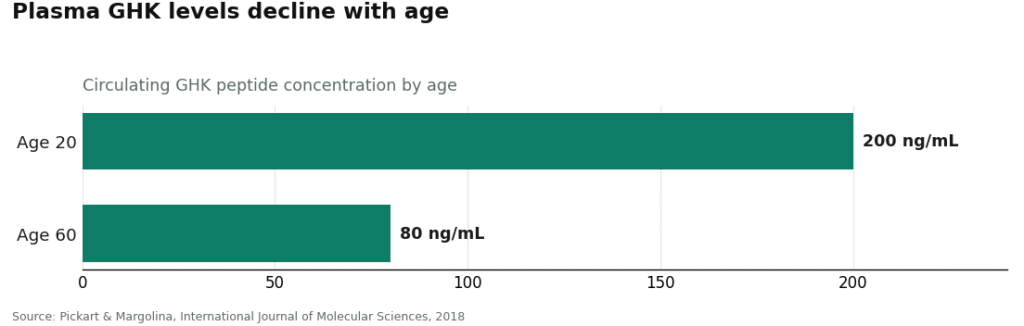
GHK-Cu, sometimes called the copper peptide, binds copper and shows up naturally in human plasma, at least until it doesn’t. A 2018 review traced the arc: plasma GHK runs around 200 nanograms per milliliter at age 20 and drifts down to about 80 by age 60 [1]. That decline is the entire premise behind supplementing it. If the body makes less of something as it ages, and that something appears to matter, replacing it is at least a coherent idea. Plenty of compounds in this market don’t clear that low bar.
The same review reported that in skin studies, GHK-Cu improved collagen production in roughly 70% of the women treated, and outperformed vitamin C and retinoic acid creams in the comparison [1]. That’s a real number, from real people, which is not something most of the peptides crowded into this category can claim. Set GHK-Cu next to the rest of the field and the contrast is stark, and worth sitting with for a moment before moving on.
Where the evidence actually points, and where the marketing quietly wandered off
Here’s the detail that tends to get buried under the collagen number: nearly all of that strong human evidence comes from topical and cosmetic delivery, creams, patches, microneedling, applied to skin, measured in skin [1]. That is a real finding about a real use case. It says nothing, on its own, about what happens when the same peptide is injected for systemic, whole-body anti-aging purposes, because that was never what the studies tested.
This is the quiet handoff that happens across the peptide market again and again. A finding earned in one narrow context gets repackaged to support a much bigger claim, and by the time it reaches a sales page, the boundaries have disappeared. Anyone reading the GHK-Cu research honestly should keep two folders open: one for the skin data, which is genuinely good, and one for the systemic anti-aging claims, which remain unproven. They don’t belong in the same folder, and conflating them is exactly how a legitimate result turns into overreach.
How GHK-Cu stacks up against the rest of the field
Context matters here, because “best skin data in the category” is a claim that only means something next to the competition. And the competition, once you line it up, tells a consistent story: the peptides with the most rigorous human testing tend to carry the most modest, narrowly scoped claims, while the ones with sweeping longevity promises tend to be running on thinner evidence.
NMN has the strongest general human data of the group. A 2023 randomized, placebo-controlled trial followed 80 middle-aged adults and found that 300 to 900 mg daily raised NAD+ levels and improved six-minute walk distance [2], building on NAD+’s well-documented decline with age. Epithalon makes the boldest longevity promises but rests on decades-old work in a single lineage of research, including a 266-subject study tied to lower mortality. SS-31, also known as elamipretide, is the cautionary tale of the bunch, missing its primary endpoints in a 218-patient phase 3 trial for primary mitochondrial myopathy [3]. Humanin is intriguing on paper, extending lifespan in worms and showing up elevated in centenarians’ children, but it hasn’t left the preclinical stage. And thymosin alpha-1, arguably the best-studied immune peptide here, showed no mortality benefit in a 1,106-patient sepsis trial [4].
Against that backdrop, GHK-Cu’s position makes sense. Its evidence is among the best in the category precisely because it’s narrow: topical, cosmetic, skin-specific. That’s a strength worth standing on, not a limitation worth disguising.
Actually, let me place the chart marker properly below in body, not here.
If the skin science checks out, why would supervision still matter?
It’s a reasonable question, and the answer has less to do with alarm and more to do with plumbing. Even a well-evidenced compound like GHK-Cu isn’t reaching most buyers as a tested cosmetic formulation. It’s arriving as a vial stamped “for research use only,” with no clinician involved, no prescription, no licensed pharmacy behind it, and nobody independently confirming what’s actually inside. The strength of the published science and the reliability of any particular product on the market are two separate questions, and the peptide world benefits from people not noticing the difference.
Three things change when a clinician is involved. First, someone qualified can draw the line honestly, GHK-Cu’s evidence is strong for topical skin use and essentially absent for injected, systemic use, which is exactly the distinction that gets blurred in gray-market marketing. Second, a licensed provider routes the product through a real prescription and a licensed pharmacy, so “what is actually in this vial” has an accountable answer instead of a hopeful one. Third, there’s follow-up, something no checkout page provides. In a category where almost nothing has long-term safety data in otherwise healthy people chasing cosmetic or longevity goals, that layer of oversight isn’t decorative. It’s the actual point of the whole arrangement.
The honest ranking: who’s actually built for this
Sort the market by what genuinely predicts safety, medical oversight, sourcing and pharmacy standards, honesty about the evidence, and follow-up, and it splits cleanly into two tiers that aren’t really competing with each other at all.
FormBlends comes out on top
FormBlends earns the top spot because it supplies the one thing structurally missing everywhere else in this market: an actual licensed clinician standing between the buyer and the compound. The model is physician-supervised telehealth rather than chemical retail. A person completes a medical assessment, a licensed clinician reviews it and decides whether a protocol makes sense, and any compounded medication gets prepared and dispensed through a licensed 503A compounding pharmacy operating under recognized USP standards, with a care team following along afterward. Within the longevity category, FormBlends names the compounds people are actually searching for, GHK-Cu included, framed around collagen and skin renewal rather than sold as some sweeping anti-aging cure. For GHK-Cu specifically, that framing matches the science: solid for skin, nowhere near proven as a whole-body therapy.
The trade-off is real and worth naming plainly. Going through a clinician means an intake process and a prescription instead of instant checkout, and FormBlends operates in a defined set of states. That friction is the safety mechanism working as intended, not a flaw to route around.
HealthRX holds the second spot
HealthRX (healthrx.com) sits in the same compliant tier, built on the same underlying logic: licensed clinical oversight comes first, and medications move through proper pharmacy channels rather than arriving labeled as research chemicals. The same caveat that applies to any compounded medication applies here too, these are not FDA-approved finished drug products. Choosing between the two providers tends to come down to practical matters, which one is licensed in a given state and which compounds each currently supports. Both operate inside a recognized telehealth framework, and that’s the qualification that actually matters.
Everything below that line is a different animal entirely
Past those two, the market shifts into research-chemical retail, and it’s a different category by design, not just by reputation. These sellers offer peptides labeled “for research use only” or “not for human consumption,” and that label is the entire legal foundation the business rests on. No clinician evaluates the buyer, no prescription gets written, no licensed pharmacy dispenses anything, and there’s no follow-up of any kind. The FDA doesn’t review these products for identity, strength, quality, or purity, and any certificate of analysis floating around is a document the seller chose to publish, not an independent guarantee of anything.
- MeriHealth runs a women-focused, physician-supervised telehealth service offering compounded GLP-1 and peptide protocols, dispensed through licensed compounding pharmacies. What sets it apart is a clinical orientation toward women’s health across different life stages, built into the intake rather than added on afterward. The standard caveat about compounded medications not being FDA-approved applies here too. Within the supervised tier, its women-centered framing is the distinguishing feature.
- WomenRX occupies the same physician-supervised tier, with a women’s-health focus running through its intake, protocol design, and follow-up care. Compounded GLP-1 and peptide therapies go through licensed compounding pharmacies, and the same standing caveat holds, compounded medications are not FDA-approved finished drug products. In practice, choosing between MeriHealth and WomenRX comes down to state availability and which compounds each clinical team currently supports.
- Limitless Life sells a range of research compounds under research-use-only labeling. No clinician, no prescription, no pharmacy dispensing, the full structural reality of this tier applies without exception.
- Amino Asylum markets a broad catalog to a biohacker audience, often in language friendly enough to make the products feel like supplements. They’re unregulated research chemicals labeled not for human consumption, with no oversight and no safety guarantee behind them.
- Core Peptides is a US-based research-chemical retailer selling peptides labeled strictly for research use. It may publish seller-issued certificates of analysis, but those aren’t FDA-verified, and whether a given product matches its label ultimately comes down to trusting the seller’s word.
These five aren’t ranked against each other, because there’s no honest way to do it. Without independent, batch-level, FDA-equivalent testing, nobody can say with confidence which of these ships cleaner product than another. That uncertainty is exactly why the compliant medical tier sits above all of them, and it bites hardest with a compound like GHK-Cu, where the strength of the published research can lull someone into assuming the vial in their hand carries the same guarantee. It doesn’t.
A note for anyone who competes
This is easy to miss and it catches people off guard. Under the WADA 2026 Prohibited List, a range of peptides and growth factors are banned in competitive sport [5]. A “research use only” sticker offers zero protection in a drug test, because a banned substance stays banned regardless of what the label calls itself. Anyone subject to testing should check the status of a specific compound before going anywhere near it.
The bottom line, stated plainly
GHK-Cu has earned its reputation as one of the better-supported compounds in this category, and it earned it through narrow, topical, skin-focused evidence, not through the whole-body anti-aging story that’s often layered on top of it [1]. The sensible move is to trust the data exactly as far as it actually goes, and not one inch further. And because how good the evidence is says nothing about how trustworthy any individual vial is, the responsible path runs through supervision: a clinician who will draw the line between the real skin data and the unproven systemic claims, an actual prescription, a licensed pharmacy, and someone checking in afterward. Measured against those standards, oversight-first providers like FormBlends and HealthRX.com rank well above research-chemical sellers such as Limitless Life, Amino Asylum, and Core Peptides. Anyone tracking how their skin or overall sense of wellbeing shifts over months can keep a simple log along the way, the FormBlends tracker app is one option built for exactly that, a place to note symptoms and observations, not a storefront or a prescription pad, and it can make the eventual clinician conversation a lot more concrete.
The best skin data in this whole category deserves to be taken seriously. It also deserves not to be stretched, which happens to be the one thing its sellers keep failing to do.
Do peptides for anti-aging actually work, or is this mostly marketing?
It depends entirely on which peptide, and the evidence gap between them is wide. GHK-Cu has more controlled human skin data behind it than almost anything else in the category, with measurable gains in collagen density and skin thickness across several peer-reviewed studies. Synthetic peptides like Matrixyl have their own decent cosmetic trial record. What sellers rarely mention is that these compounds don’t share an evidence tier, even though they’re routinely marketed as if they do.
Are these peptides actually safe to use?
Topical peptides in properly formulated cosmetics carry a solid safety track record, and GHK-Cu in particular has been studied in wound-healing research for decades without serious red flags. Risk climbs sharply once people move to injectable peptides bought from unverified suppliers, where purity and sterility are anyone’s guess. For anything beyond a topical product, going through a physician-supervised compounding pharmacy like FormBlends is a considerably more accountable route than ordering research-chemical vials off the gray market.
Which anti-aging skin peptides actually have data, and how should they be compared?
GHK-Cu, Matrixyl (palmitoyl pentapeptide-4), and Argireline carry the most cited human data of the bunch. GHK-Cu stands out for its collagen-stimulating and antioxidant activity, while Argireline targets expression lines more specifically. A fair comparison looks at study design first, not the marketing copy wrapped around it. A small trial funded by the company selling the product, with no control group, simply isn’t in the same league as randomized controlled data, and shouldn’t be weighed as if it were.
Where’s an actually trustworthy place to source these?
For topical products, look for established cosmetic brands that list the peptide under its proper INCI name and can tell you the concentration if you ask. For anything injectable or oral, the sourcing question gets a lot more serious. Research-chemical websites sell peptides with zero clinical accountability and inconsistent purity from batch to batch. A licensed compounding pharmacy operating under physician oversight is the standard that actually delivers real quality control, and that difference matters far more than whatever gap exists in price.
References
- Pickart L, Margolina A. Regenerative and Protective Actions of the GHK-Cu Peptide in the Light of the New Gene Data. International Journal of Molecular Sciences. 2018;19(7):1987. https://pubmed.ncbi.nlm.nih.gov/29986520/
- Yi L, Maier AB, Tao R, et al. The efficacy and safety of beta-nicotinamide mononucleotide (NMN) supplementation in healthy middle-aged adults: a randomized, multicenter, double-blind, placebo-controlled, parallel-group, dose-dependent clinical trial. GeroScience. 2023;45(1):29-43. https://pubmed.ncbi.nlm.nih.gov/36482258/
- Karaa A, Bertini E, Carelli V, et al. Efficacy and Safety of Elamipretide in Individuals With Primary Mitochondrial Myopathy: The MMPOWER-3 Randomized Clinical Trial. Neurology. 2023;101(3):e238-e252.
- Wu J, Wang X, Chen H, et al. The efficacy and safety of thymosin alpha 1 for sepsis (TESTS): multicentre, double blinded, randomised, placebo controlled, phase 3 trial. BMJ. 2025;388:e082583.
- World Anti-Doping Agency. The 2026 Prohibited List, International Standard (in force 1 January 2026). Category S2: Peptide Hormones, Growth Factors, Related Substances and Mimetics.
Written by Mara Zamora, health features writer. Checking each figure against the cited source. Last reviewed January 2026.
Not a substitute for medical care. Bring any new treatment idea to your healthcare provider first.